Representative of the PhD/PostDoc initiative: since June 2025: Antonia Louisa Böhmert (PhD student)
The goal of the PhD/PostDoc initiative is to represent the interest and perspective of the PhD students and PostDocs working within SFB1129 and to independently decide on their current needs. In addition, we want to offer opportunities to further their academic career and interact with people from different positions within academia. This way, we are able to see different viewpoints and combine perspectives from a wide variety of research fields and career stages. This can be clearly seen throughout the program offered by the initiative, focussing on many different aspects of research and academia.
During the first funding period Andrea Imle continuously represented the PhD/PostDoc initiative. For the second and third funding period we decided to give more people the opportunity to take over this very interesting function by defining a term of one year for each representative.
In 2019 Ines DeCastro (PostDoc; project 20) took over this role, followed by Severina Klaus (PhD student; project 18) in 2020, Marianne Papagrigorakes (PhD student; project 3) in 2021, Samy Sid Ahmed (Postdoc, project 8) in 2022 and 2023, Annett Petrich (Postdoc, project 5) in 2024 until May 2025.
From June 2025 until the end of the third funding period (June 2026) Antonia Louisa Böhmert (PhD student, project 23) is the representative of the initiative.
Reports from the PhD / PostDoc-Initiative
2025
In 2025, we successfully continued our series of online seminars, allowing us to welcome speakers who might not have been able to attend in person. Through the PhD/PostDoc initiative, we hosted guests from a wide range of professional backgrounds who generously shared their insights on career development, decision-making, and research opportunities. These informal sessions fostered a welcoming and dynamic atmosphere, encouraging meaningful dialogue between SFB PhD students, PostDocs, and our invited speakers.
We kicked off the series with Daniel Lauster, Professor at the Free University of Berlin (Biopharmaceuticals), Chief Scientific Officer at MucosaTec, and Associate Editor at Nature — NPJ Viruses. He shared his inspiring career journey — from his postdoctoral days to starting his own lab and leading a research group. Daniel outlined the essential milestones on the academic path from junior group leader to professorship, including leadership skills, administrative responsibilities, teaching, grant writing, and publishing. He also emphasized the importance of networking, recognition through awards, and how these elements can strengthen grant proposals. Drawing on his own experience, Daniel introduced the audience to SPRIND, a new funding option for start-ups, and discussed his role as CSO at MucosaTec. Finally, he gave a behind-the-scenes look at his editorial work with NPJ Viruses and shared how he effectively balances his multiple professional roles without becoming overwhelmed.
In the following seminar, Dr. Shreya Ghosh, Science Writer and Communications Editor at EMBL, offered an insightful deep dive into the world of science publishing and communication. She highlighted the key skills required for a successful career in this field, including writing, storytelling, and translating complex science for diverse audiences. Shreya discussed practical ways to gain experience — such as internships at The Scientist, completing courses in scientific writing, and building a portfolio through blogging or freelance work. She also shared her own career journey, which spans roles from science blogger to program manager to professional science communicator, illustrating how diverse experiences can shape a path into science writing. Shreya explained the different formats and strategies used in science communication, including tailoring content for non-expert audiences versus scientific peers. Drawing from her professional experience, she also addressed common challenges in the field. To support aspiring communicators, she provided a valuable list of professional organizations, newsletters, websites, courses, and books that can help develop and refine science writing skills.
We also had the pleasure of hosting Dr. Elina Nürenberg-Goloub, Medical Writer and Data Scientist at the Data Science Group Frankfurt | University Hospital Frankfurt (Main), who engaged us in a fascinating discussion about her non-linear career path and how it led to her current role. Elina provided a comprehensive overview of her multifaceted position, which spans medical and scientific writing, project management, data science, and data protection. She shared what motivated her to pursue such a dynamic and interdisciplinary field and gave us insight into her daily work at the intersection of medicine, research, and technology — collaborating closely with medical professionals across a variety of topics. Elina also spoke about some of the exciting projects she is currently involved in at the Data Science Group Frankfurt. In addition, she offered valuable guidance on the key skills needed for success in this field, how to build a strong portfolio, where to look for relevant opportunities, and what to expect during the application and interview process.
We continued our series with Dr. Anna-Dorothea Gorki, Chief Scientific Officer at YGION Biomedical | GST Antivirals, sharing her journey from academia to her current role. Thea provided valuable insights into the responsibilities of a scientific officer, highlighting the shift from wet-lab work to a strategic leadership position. She discussed the key skills — both technical and interpersonal — necessary for success in this field. As a recruiter, she also shed light on the application and interview process, the importance of workshops and networking, and the intricacies of securing funding. Additionally, Thea emphasized the art of pitching ideas concisely, an essential skill in today’s fast-paced industry. She also compared the dynamics between big pharma and start-ups, providing a clear picture of the current job market landscape.
We were thrilled to host Dr. Annica Flemming, Senior Manager of Regulatory Affairs at Merz Therapeutics, for an insightful session. Annica shared her journey from academia to her roles as Project Manager at Serum Life Science Europe GmbH (formerly Vakzine Projekt Management GmbH) and Regulatory Affairs Manager at Merz. She offered a detailed look at the responsibilities in each role, highlighting the key differences between project management and regulatory affairs. Annica also provided valuable insights into the application and interview processes at both large pharmaceutical companies and smaller firms, and discussed the growing influence of AI in these processes. Additionally, she shared her experiences with AIDS-Hilfe Heidelberg e.V. and offered a thoughtful perspective on balancing volunteer work with her professional responsibilities.
These seminars provided us with a deeper understanding of various professional roles and inspired us to reflect on our own career aspirations. The speakers shared invaluable advice on overcoming career challenges, maintaining a healthy work-life balance, and handling setbacks. They also opened-up about key moments in their careers — both the successes and the unexpected detours — giving us a well-rounded perspective on their career journeys.
This year, the PhD/Postdoc Initiative organized an interactive workshop titled “Young Female Leaders in Science“, led by Sue Hewitt from hfp consulting. Over the course of two days, we explored the wide range of opportunities within scientific careers and how to navigate them effectively. We gained valuable insights into our personal values, strengths, and unconscious biases, and developed tailored strategies to tackle professional challenges while maintaining a healthy work-life balance. The workshop provided practical tools to sharpen our skills and foster self-reflection, helping us make more informed decisions about our future. Sessions on networking, CV preparation, and interview techniques were especially impactful, offering concrete guidance on how to adapt our professional profiles to various career paths and present ourselves confidently in the job market. It was an engaging, informative, and inspiring course — one that has left a lasting impression and equipped us with skills and strategies we will carry forward throughout our careers.
– Annett Petrich, Representative of the PhD/PostDoc Initiative, SFB1129 –
2024
During the PhD/PostDoc initiative seminars, we had the privilege of hosting guests from diverse professional backgrounds who shared valuable insights on various career paths, choices, and research opportunities. These informal sessions provided a relaxed and engaging environment for meaningful discussions between SFB PhD students/PostDocs and the speakers.
Our first session featured Dr. Charlotte Kaplan, who shared her fascinating career journey, from her time as a postdoc in the US to her work at AbbVie. She also discussed her current role as a super-resolution microscopy specialist at the BioQuant Image Core Facility. Dr. Kaplan provided a unique perspective on transitioning from academia to a data science role and then returning to academia, illustrating the varied opportunities within scientific careers.
In the following seminar, Dr. Lyras Ekaterinithen, an editor at Nature Communications, gave us an in-depth look into the world of science publishing. She explained the editorial process and discussed her career transition from academia to publishing, providing valuable insights into the responsibilities and challenges of her role. Her talk was both engaging and thought-provoking, offering a comprehensive view of a potential career path in science publishing.
We also had the opportunity to engage in fascinating discussions with Dr. Neeraja Sankaran, a scientific historian and writer at Ahmedabad University. Dr. Sankaran shared her unique career trajectory, which spans from microbiology to science history, editing, and authorship. Her experiences highlighted the diverse avenues for those interested in combining science with the humanities.
Additionally, Dr. Arina Rybina, a Scientific Project Manager and Advanced Imaging Specialist at EMBL-Euro-BioImaging Bio-Hub, spoke about her transition from academia to her current role. She provided valuable insights into the responsibilities of a scientific project manager and the impact her work has on research initiatives at the Euro-BioImaging Bio-Hub.
These seminars not only gave us a broader understanding of different professional roles but also encouraged us to reflect on our own career aspirations. The speakers offered advice on navigating career challenges, managing work-life balance, and dealing with setbacks. They also shared pivotal moments in their careers, including both successes and detours, offering us a holistic view of their career paths.
– Annett Petrich, Representative of the PhD/PostDoc Initiative, SFB1129 –
2023
With the end of the COVID-19 linked restrictions to in-person meetings, the PhD/Post-Doc initiative of the SFB1129 started holding regular “Think & Drink” sessions again by the end of 2022. During these sessions, invited guests from different professional backgrounds shared insights on diverse career paths with SFB students in an informal setting, allowing a relaxed and informative discussion with the different guests. A first session was held with Dr. Charlotta Funaya who gave us her insights as the head of the Electrom Microscopy Core Facility of the University. Dr. Frauke Mücksch then shared with us her experience as a postdoc in the US as well as her more recent experience as a junior group leader in the CIID. We also had interesting discussions with Dr. Céline Carret, former PI and senior editor for EMBO Molecular Medicine, who now trains young scientists at EMBO Solutions in Heidelberg. Furthermore, with the goal to promote the training of younger researchers, the PhD/Post-Doc initiative also helped to organize courses designed for both PhD students and/or Post-Docs together with the SFB staff.
– Samy Sid Ahmed, Representative of PhD/PostDoc initiative of SFB1129 –
2022
We continued our lunch talk series with Prof. Dr. Alexis Maizel (Professor for Plant Cell and Developmental Biology) who talked about his experience on the road to a Professor position (W3) in the University of Heidelberg on February 24th, 2022.
In an online talk on March 30, 2022 CIID microscopy expert Dr. Sylvia Olberg talked about her experience to leave and also return to academia in her talk “Changing perspective: Transition from academia to industry and back“.
2021
Continuing despite the difficulties imposed by the pandemic, we organized a series of online seminars with speakers who might not have been able to join in person. During these seminars, professionals talked to us about their careers, choices, options and research.
We started the series with Dr. Susan Kummer, who encouraged us to consider failure and what comes after. In the next seminar, Dr. Britta Nyboer talked to us about her current position in administration of university funding, as a way to stay in academia, but out of the lab. We also discussed with Dr. Lena Steshenko, a senior program officer at EMBO Young Investigator network, about how her work impacts research.
This year’s SFB International Meeting was also a successful online event, with PhD students and PostDocs presenting their work and progress in short presentations, receiving insightful remarks and help in a direct discussion with all groups involved.
Altogether, we managed to adapt and overcome many obstacles and provided the PhD students and PostDocs with different tools and perspectives to help them on their future path. Whether it was structured courses or discussions with experts and colleagues from different fields, with the support of the SFB1129 we have provided a fruitful platform for discussion and networking opportunities for both early and late-stage scientists within the SFB1129.
– Marianne Papagrigorakes, Representative of PhD/PostDoc initiative of SFB1129 –
2020
In 2020 we focused on all the different aspects of science that we sometimes do not see, from the big to the small. We started out strong with two events in February. First, we learned about the publishing world together with Markus Elsner, an editor at Nature Biotechnology who taught us what editors do and how a career in science publishing looks like. It was an engaging and exciting talk giving us many insights into the daily life of an editor.
Then later in the month our colleagues Annica Flemming and Carolina Matos taught us how to integrate science and humanitarian work in a seminar on science and volunteering. We covered both options far away and close to home that might inspire a few of us to reach out and participate ourselves.
Despite the challenges that arouse during spring we forged ahead with great determination and decided to hold the SFB retreat in an online format this year. Many great discussions were held via the online platform and we are excited to have twice as much fun in an in-person kick-off meeting next year.
To end the year on a high note, together with hfp consulting, we organized the interactive online workshop “Career Development for Young Scientists” in December. Together with friends and colleagues from the TRR179 and SPP1923 we spend four exciting sessions in two weeks exploring all the possibilities that science careers have to offer and how to best access them. With our two trainers Yuvalal Liron from the Weizmann Institute of Science and Romain Barrès from the University of Copenhagen, we learned how to sharpen our skills and reflect on how to improve ourselves and make better and more informed decisions in our future. It was a highly enjoyable, informative and helpful course and we will carry the lessons learned with us well into the future.
– Severina Klaus, Representative of PhD/PostDoc initiative of SFB1129 –
2019
In 2019 our PhD/PostDoc´s have learned in our seminar series about parallel careers to academia. We have started by a theme that is close to many of us, current module tutors and students’ supervisors: “Teaching”. This exciting and lively seminar was led by Dr Kaufmann (Student Coordinator of Molekular Biotecnologie, Heidelberg University), awarded by her excellence in teaching. A group of us are now participating in her teaching programme, a new adventure that could enhance our CVs.
We have also learned from a former scientist, Dr. Schwarz, what it is to be a publishing editor at Springer. It was an enlightening overview into the publishing world and who knows a possible career for some of us.
With the Heidelberg Alumni Network vice-Director, Ms Friedrich, we have explored some Alumni profiles that could translate into possible connections in many different areas, Consultancy, Pharma Companies etc. Located all over the world this network could be extremely helpful when thinking about moving into a different city.
For the SFB1129 retreat, this year we have organised a coaching session with the “Arc Founder”, Astrid Schrader. Driven by the goal of exploring your full potential at work, we took a journey into understanding what we can bring of our personalities to achieve our aims. Some participant comments: “The workshop provided us with a great opportunity to vocalize our wishes, plans and concerns about our future careers in science.”, “I felt I was in a safe place to talk about our own and each other´s current career problems and learned tricks for having a happier work life”, “It was a good opportunity to meet and discuss with other members of the SFB1129 that have similar issues”.

Participants of the SFB1129 kick off meeting during the Retreat at EMBL 2019
To complete this year we are running three afternoon sessions focused on “Leadership” tailored for PostDocs and final year PhD students that have in mind a transition to Group Leader positions or other leadership roles in parallel careers.
– Ines de Castro, Representative of PhD/PostDoc initiative of SFB1129 –
2014 – 2018
To make science even more fun …
The primary task of the PhD/PostDoc initiative is to get the topics of PhD students and PostDocs on the agenda of the SFB committee in order to make a positive change. But what can such a positive change be? Just because of the presence of a PhD/PostDoc initiative there will not be more successful experiments. But what if science would be more fun? The so-called “fun-theory” summarizes the thought that something as simple as fun is the easiest way to change people’s behaviour for the better. Diverse projects have adapted this principle for example to make recycling more attractive or to use the stairs instead of the escalator (www.thefuntheory.com). Could we also apply the “fun principle” to science within the SFB1129?
The question was, if people would more likely join a seminar and be active in a scientific discussion if it was more fun. We therefore started the “Think & Drink” seminars. To these seminars people can come with a question, they would like to discuss, and gather with others in a relaxed atmosphere without PIs. No presentation is required, but with snacks and drinks, students and PostDocs can discuss science or other questions of the lab life. After initial struggles when to have these meetings, we now have it once a month on Thursday afternoons at 5 pm – alternating with the official SFB1129 seminars.
Another project of the PhD/PostDoc initiative was to organize a VIP speaker seminar. Nobel Laureate Stefan Hell came for a round table discussion with PhD students and PostDocs. In order to enable discussions, the number of participants was limited to 25. In a relaxed atmosphere with food and drinks, Stefan Hell gave private insights into his scientific career and the questions that move him. It was an interesting discussion about ups and downs of the scientific community, the struggles for discoveries and the inspiration and satisfaction a pursued idea can provide.
The annual retreat is meant to foster scientific discussion between the groups. As in the previous year, PhD students and PostDocs could discuss their science in a poster session. Additionally this year the retreat was preceded by a whole session organized by the PhD/PostDoc initiative. The morning started with an Impulse talk by two young EMBL scientists, Lars Steinmetz and Judith Zaugg. They gave insight into their careers and turning points in their lives, things that worked out, but they included also detours and experiences, they would have loved to miss. The presentation evoked a vivid discussion and both speakers were very open to diverse questions.
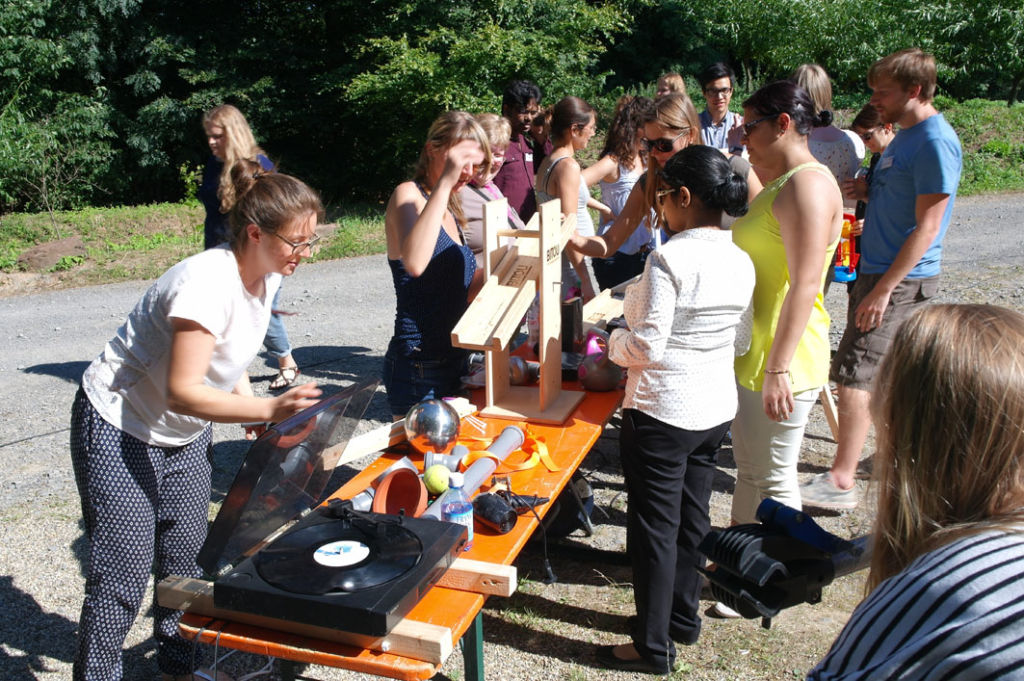
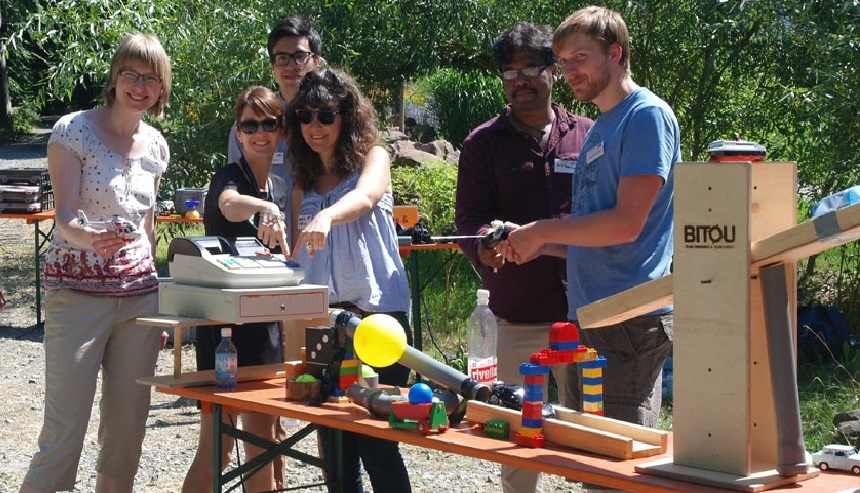
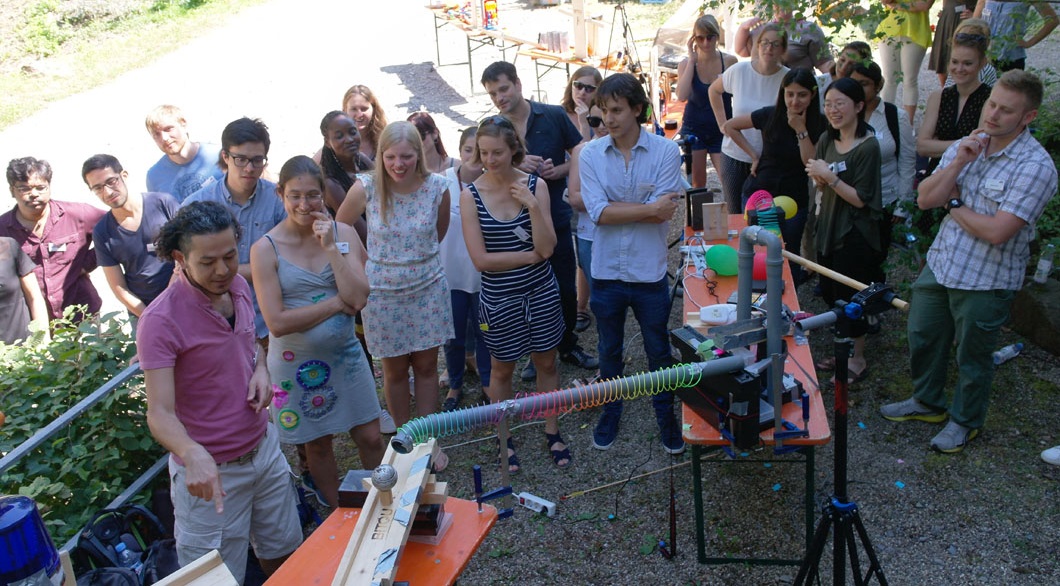
What followed was a bit of an experiment. We went outside to be active. The overall question was, if the whole retreat would be more fun if people would get to know each other better, if the idea of collaborating would become concrete and tangible. We therefore had a team event in form of a chain reaction. Similar to domino day, an initial impulse had to be propagated and amplified over some distance up to the final confetti canon. 35 PhD students and PostDocs were assigned by chance into 7 groups. Within these groups they built several stations to spread the impulse and then to transmit it to the next group. Diverse material could be used to build the chain reaction: balls, rockers and tunnels and the classic dominoes up to electric equipment such as hairdryers or record players. The building process started communication within the group and neighbouring groups. Participants described the chain reaction as a “great opportunity for students to get to know each other and break the ice” and appreciated the chance to do something practically before all the theory. In general, participants said they would appreciate a recurrence of a similar event and would recommend it for other SFBs and Transregios. It was great to see how doing something together “just for fun” could release a lot of positive energy. Everyone was involved in an activity where the overall effect is more than the sum of its individual parts. And that is what an SFB is all about in the end.
– Andrea Imle, Representative of PhD/postdoc initiative of SFB1129 –
Impressions from the team event at the Retreat in July 2016: